Enreach
Fragmented Omnichannel stack Header

The hidden cost of a fragmented omnichannel tech stack

Back to overview 01.05.2026 | Topic: Outbound Sales Software

Running a contact centre across voice, email, chat and messaging is complex enough. Running it across four or five disconnected platforms makes it significantly more challenging – and expensive.  

For contact centre leaders, a fragmented omnichannel tech stack is one of the most common - and most underestimated - sources of operational cost.  

This guide explains what that fragmentation is really costing, and how teams are consolidating onto a single omnichannel contact centre platform without replacing their existing infrastructure.

Why contact centre tech stacks become fragmented 

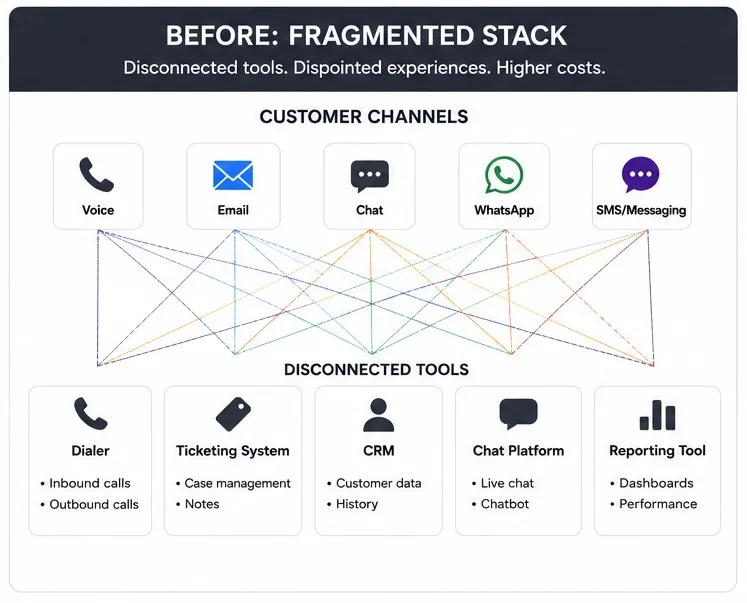
Contact centre fragmentation rarely happens by design. Most operations start with voice, then add chat, then email, then WhatsApp as customer expectations evolve. As volumes grow, a ticketing system is introduced, and then a reporting tool gets added because the existing platforms can't give supervisors what they need. 

At the time, each decision makes sense, but the cumulative effect is a contact centre technology stack where agents are piecing together a coherent customer picture from multiple disconnected systems - mid-conversation - putting them under pressure, every single day. 

What does a fragmented omnichannel stack actually cost? 

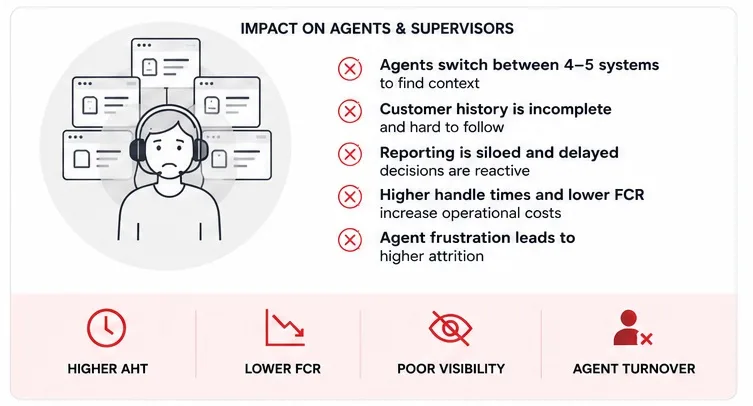
The operational impact of a disconnected contact centre stack shows up in four predictable places: 

Average handle time (AHT) increases when agents switch between systems to find context they should already have. Every toggle between a CRM, ticketing tool and chat platform adds seconds, and those seconds compound across thousands of interactions. 

First contact resolution (FCR) drops when customer history is spread across platforms and handoffs are incomplete. Customers repeat themselves. Agents resolve less. 

Supervisor visibility suffers when performance data lives in separate systems. Real-time decisions get made on incomplete information, making it harder to identify problems before they affect service levels. 

Agent experience deteriorates - which in a competitive labour market carries its own costs in attrition and onboarding. 

The data backs this up. When a leading bank consolidated their contact centre operations onto a single omnichannel platform with deep Salesforce integration (replacing a fragmented multi-tool setup with a unified agent desktop) they achieved a 10-20% reduction in average handle time and a 15-25% improvement in first contact resolution. The change wasn't in their people or processes. It was in giving agents the full picture in one place. 

At a leading BPO, moving from a fragmented on-premise setup to a unified cloud platform delivered a 30-45% reduction in operational costs, and gave their team the ability to self-manage 90% of call flows without external consultancy. 

In both cases, the technology wasn't the bottleneck. The fragmentation was. 

Three signs your contact centre tech stack is costing you more than it should 

  1. Agents regularly access more than two systems per interaction.
    Every additional platform adds friction, increases error risk and extends handle time. A unified omnichannel agent desktop eliminates this. 

  2. Supervisors can't see real-time performance across all channels in one view. 
    Fragmented reporting means decisions are made on incomplete data. A single omnichannel platform gives supervisors live visibility across voice, email, chat and messaging simultaneously. 

  3. Customer context doesn't follow the interaction across channels. 
    If a customer moves from chat to a phone call and the agent starts from scratch, the omnichannel experience has broken down — regardless of how many channels you offer. 

What a more connected contact centre setup looks like 

The contact centres seeing the strongest performance improvements right now aren't always the ones with the most sophisticated technology. They're the ones where the technology actually works together - a single agent view, a platform that adapts to existing processes, and reporting that gives supervisors real visibility across every channel. 

How Enreach Omnichannel reduces contact centre stack complexity 

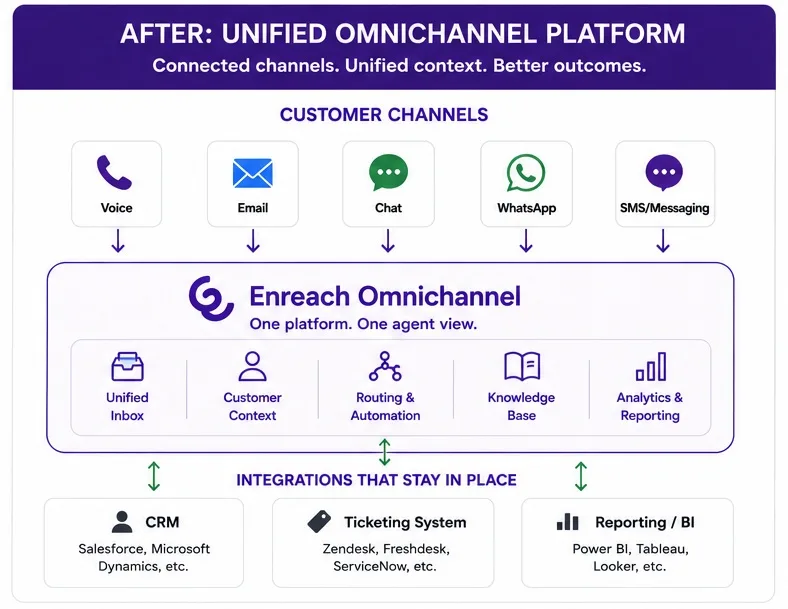
The most immediate fix for a fragmented omnichannel stack is consolidating the channels themselves. Rather than running voice, chat, email and WhatsApp across separate tools, Enreach Omnichannel brings them into a single platform, giving agents one interface to manage every customer interaction, regardless of channel. 

What stays in place is your CRM and ticketing infrastructure. Enreach Omnichannel is built to work with both - and flexibly:

  • For teams who prefer to work inside their CRM, Omnichannel can be embedded directly, allowing agents to manage interactions without leaving Salesforce, Zendesk or Microsoft Dynamics.  

  • For teams who prefer to keep Omnichannel as the primary workspace, CRM data can be pulled directly in, so agents still have full customer context without switching systems. 

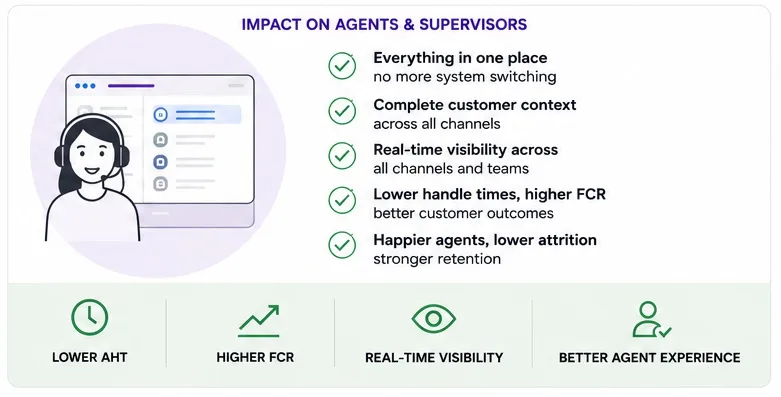
Either way, the result is the same: agents have everything they need in one place, customer context follows every interaction, and supervisors get unified reporting across all channels. 

If you're running a contact centre and want to see what that looks like in practice, we'd be happy to show you.