
Most contact centre managers don't struggle to find omnichannel platforms. They struggle to evaluate them.
Every vendor leads with the same promises: unified channels, seamless customer experience, AI-powered everything. And of course, enterprise platforms offer more than most operations need, whilst lighter tools don't offer enough.
In this article we cover what actually matters. Here's five questions to ask your omnichhnnel contact centre vendors.
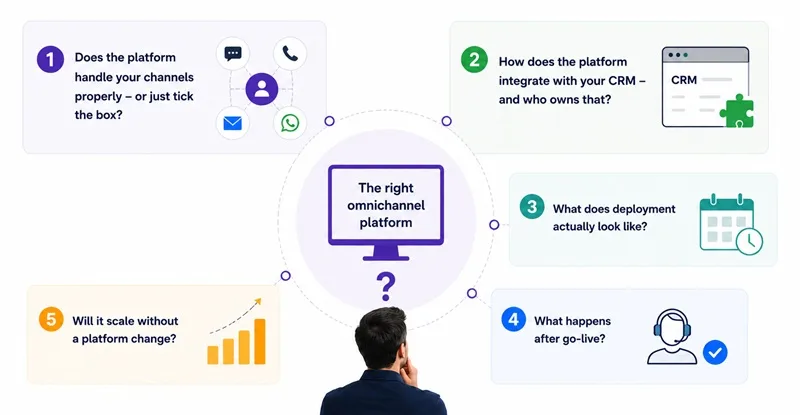
The question to ask vendors isn't "which channels do you support?" but "how does an agent handle a conversation that moves from one to another?" If the answer involves switching screens or losing history, the ‘omnichannel’ claim is thinner than it looks.
In modern contact centres, it's critical to have voice, email, chat and messaging in one single agent interface, with customer history visible regardless of channel - that's what reduces handle time and improves first-contact resolution.
Your CRM is not going anywhere. Any omnichannel platform needs to work with it properly, either embedded into your CRM, or pulling that data into the contact centre view. Both can work. What matters is whether the integration is native (a built-in, direct connection) and supported by the vendor, or relying on a third-party connector that introduces another point of failure.
Enterprise contact centre platforms are powerful, BUT built for large, complex environments. This oftern means that 6-12-month plus projects using expensive specialist consultants are common. For many operations, the implementation overhead often outweighs the benefit.
The right question, therefore, isn't "how long does it take?" but "who does what, and what does that cost?"
Look for systems with native integrations and a proven onboarding process - they will get you to go-live faster, with a lower risk of project-creep, and with an earlier ROI.
This is the question most commonly skipped in the evaluation process.
Some omnichannel platforms are sold and handed over. Others come with a customer success team that helps you optimise performance over time - included in the contract, not billed separately.
For contact centres without large internal IT teams, that ongoing support is a practical requirement, not a nice-to-have.
A modular platform lets you pay for the capabilities you need now, with a clear path to add features as requirements change. It's important to consider things such as: how much configuration do you want to be able to manage without a vendor support ticket? And can you add a new channel or integration without a significant project?
Before you shortlist, run any platform against these five questions:
Can agents handle every channel from a single interface, with full customer history?
Does the CRM integration work with your specific setup — and who owns it when something breaks?
What does deployment actually cost, beyond the licence fee?
Is post-go-live support included — and what does it actually cover?
Can the platform scale without a major project?
If a vendor struggles to answer any of these clearly, that's useful information.
Enreach Omnichannel is built for contact centres that need solid, scalable capability without enterprise-grade complexity. It handles voice, email, chat and messaging in a single platform, integrates with many CRMs, such as Salesforce, Zendesk and Microsoft Dynamics, and deploys quickly using native integrations and a dedicated onboarding team.
For teams already on Enreach Outbound, it sits alongside your existing setup - adding inbound and digital channel management without disrupting what's working.
Book a 30-minute demo to see what it looks like in practice.