Enreach
Simplifying your omnichannel setup Header

Simplifying your omnichannel contact centre - without starting from scratch

Back to overview 01.05.2026 | Topic: Outbound Sales Software

Many contact centre managers struggle with a fragmented omnichannel set-up - agents switching between systems to chat or email customers, customer history spread across platforms, reporting that never quite adds up. 

The problem isn't their lack of desire to change this. It's their assumption about what fixing it involves. 

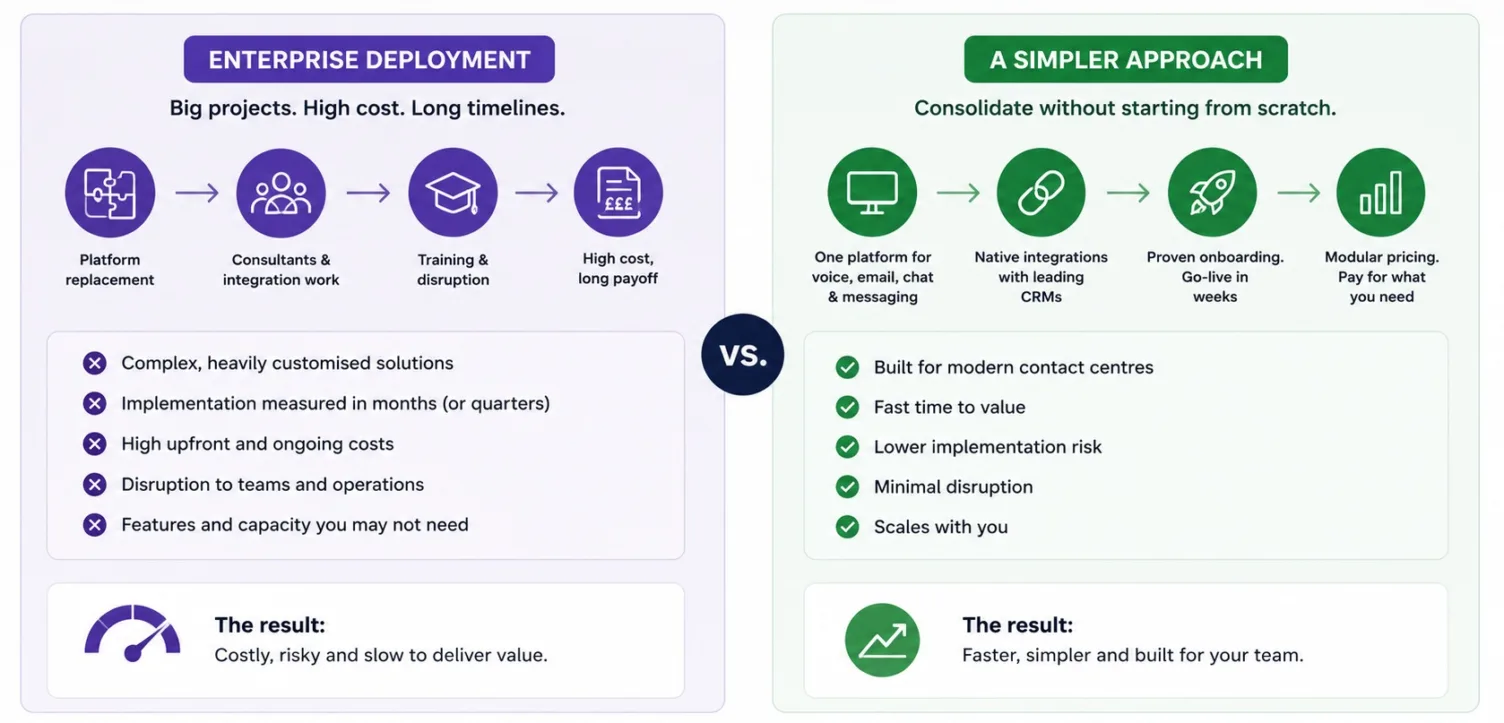
That assumption goes something like this: sorting it means a platform replacement. A platform replacement means a project. A project means consultants, integration work, training, disruption - and a bill that lands somewhere between uncomfortable and eye-watering.

The result is that they manage with what they have.

The problem with enterprise contact centre deployments 

It's often fair to say that this assumption is true of enterprise deployments. The largest contact centre platforms in the market are powerful, but they're engineered for large, complex, multi-region environments - and this means they have long implementation timelines and heafty price tags to reflect this.

But that's not the only model. 

There is another option 

If you’re looking to consolidate a fragmented set-up, the goal doesn’t have to be a custom-built, heavily configured solution. Instead you can look for a platform that handles your channels properly, integrates with the CRM you already use, and gives your team one place to work instead of four. 

That's a much more contained problem than the enterprise version. And it's one that modern omnichannel platforms - built specifically for modern contact centres - are designed to solve without the overhead. 

  • Modular pricing means you're not paying for features that don't apply to your operation. 

  • Native integrations with leading CRMs mean the connection between your contact centre and your customer data is built and supported by the vendor, not reliant on a third-party connector. 

  • Proven onboarding processes mean go-live is measured in weeks, not quarters.  

The result is faster time to value, lower implementation risk, and a team that's up and running before the project fatigue sets in. 

Complexity isn't the same as complicated 

It would be unrealistic to say that evolving your omnichannel set-up is without complexity. Channel configuration, routing logic, and even agent training all take time and resource investment. But there's a big difference between complexity that you manage once during a system setup, and complexity that's baked into the platform permanently. 

The question worth asking isn't "can we afford to do this?" It's "can we afford to keep managing the fragmentation we have?" 

For most contact centres, the answer to the second question is already clear. The implementation assumption is the thing that's been getting in the way.

What a simple omnichannel contact centre deployment looks like in practice 

Enreach Omnichannel is built for contact centres that need to consolidate without starting from scratch. It handles voice, email, chat and messaging in one platform, integrates with leading CRMs, such as Salesforce, Zendesk and Microsoft Dynamics, and is designed to deploy without enterprise-level complexity or cost. 

For teams already using Enreach Outbound, it sits alongside your existing setup - a separate platform that adds inbound and digital channel management without touching what's working. 

Book a 30-minute demo to see what implementation actually looks like.