Before you continue

To give you the best possible experience please select your preference.

Enreach
homepage.jpg

Why speed-to-lead matters more than ever in 2026 ​(And how web callback technology changes the game)

Back to overview 11.02.2026 | Topic: Outbound Sales Software

When a prospect fills out a form on your website, they’re raising their hand and saying, “I’m interested”.

They’re no longer passively browsing, they’re now actively interested - and in that moment, timing is everything.

Yet for many businesses, that form completion still triggers a slow, manual process: a CRM entry, a queue, and a follow-up call a few hours (or days) later.

By then, the moment is gone.

This is where speed-to-lead, using modern web callback technology, becomes a decisive competitive advantage.

What is speed to lead?

Speed to lead is the time it takes for your business to respond to a lead. This is often also called your “lead response time”.

It doesn’t matter what channel you use to respond, the clock starts ticking the minute the prospect clicks “submit”, and every minute that follows will impact your conversion of that lead.

Why is speed to lead so important?

It’s widely understood in sales and marketing that the faster you follow-up a web lead, the more likely you are to qualify it and turn it into a paying customer.

The five minute rule has existed for many years and research shows that contacting a lead within 5 minutes makes you 21× more likely to qualify them compared with waiting 30 minutes.

But in today’s ‘always-on’ digital environment, even five minutes can feel like a lifetime. “Fast” is now often too slow, and has been replaced by “instant”.

According to a recent study, calling a lead within the first minute of the enquiry increases conversions by 391 %. But if you call just one minute later, that number drops to just 120 %.

For organisations that are dialling leads, these statistics are vitally important: they are the difference between hitting and missing conversion KPIs.

The hidden costs of a slow response

When prospects submit a form, they’re usually actively researching and comparing their options. They’re ready to speak now - not later.

A slow response doesn’t just hurt conversions, it signals that you’re hard to do business with, and gives faster competitors the chance to make a better impression.

How to improve speed to lead with a web callback widget

A web callback widget connects website form submissions directly to your sales or support agents in real time - rather than simply passing their details into a CRM queue to be called later.

With a traditional web form, enquiries are often routed into a CRM workflow, where they wait to be picked up by an agent. Even with automation, this can introduce delays of minutes or hours. Web callback removes that waiting period entirely.

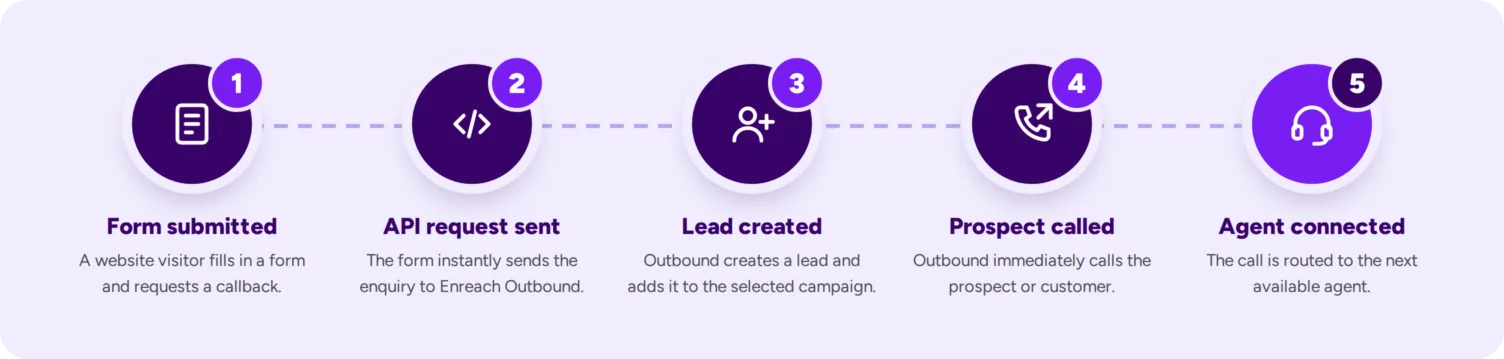
A typical web callback process works like this:

  1. A prospect fills out a form on your website
  2. The system instantly creates a lead in the relevant campaign of your dialer
  3. The dialer immediately dials the prospect
  4. The call is routed to the next available agent

Instead of asking agents to work through a list of form submissions, web callback treats online enquiries like live inbound calls.

When integrated with an intelligent dialler such as Enreach Outbound, these callback requests are automatically prioritised and routed based on agent availability or skill set, so prospects are connected within seconds, not minutes.

Why web callback has become a competitive advantage

1. Buyer expectations have changed

Today’s buyers are used to instant responses, supported by one-click ordering, live chat support and real-time notifications functionality.

When you respond immediately, it aligns with those expectations. When you don’t, the customer experience feels outdated, there’s instant disappointment and sometimes this triggers prospects to look elsewhere, no matter how good your product.

2. Intent Is highest at the moment of form submission

Web callback technology capitalises on that moment when a buyer’s interested is peaked. Calling immediately dramatically increases answer rates. The prospect expects the call - because they just asked for it. It’s the optimum time to talk.

3. Faster conversations equal higher quality conversations

When agents speak to prospects immediately, the product is fresh in their mind, and they’re motivated and willing to talk. This often leads to more productive calls, better qualification, and shorter sales cycles - without increasing outbound volume.

Maximise the value of high-intent leads

When your website is attracting and converting visitors, you want to be sure you are optimising your chances of converting every lead. A web callback widget closes the gap between interest and engagement, so you can maximise ROI.

Speed to lead is easy to achieve with the quick-to-implement web callback widget from Enreach Outbound. Talk to us today xxxxx