Our sites
justin-hamilton-martin
Back to overview
February 18, 2021 · 3 min read

First The Traditional Now The Rise Of The ‘Casual’ Contact Centre

Alongside the market for traditional contact centre solutions, we are seeing the emergence of ‘casual contact centres’. Based on cloud technology, these are being adopted by businesses who require some element of ‘contact’, but are often SMEs who do not have the resources or requirement for larger or dedicated contact centre systems. Casual contact centres also open up the potential for a wider audience of resellers and service providers.

The growth of this more informal approach to contact centres has recently been propelled by two drivers: continued advances in technology, and the pandemic. As we all know, in 2020 businesses of all sizes had to rapidly pivot to online models in order to survive. Very quickly, much of the customer experience was narrowed down to a digital screen.

At first, the focus was just on keeping the lines of communication going, but businesses soon realised that initial ‘quick fixes’ often based on consumer tools are not viable for the long time: they often lack sufficient performance, functionality or integration with other applications. Therefore, looking at longer-term ways to improve the digital environment has become a priority.

At the same time, the technology that powers the casual contact centre has evolved, underpinned by Unified Communications as a Service (UCaaS) in combination with Contact Centres as a Service (CCaaS). When implemented well, contact becomes seamless across devices, networks, channels and users. Plus, cloud makes it faster and simpler to integrate inbound and outbound channels, including email, SMS text, phone, WhatsApp, social media, customer conversations within apps, and more.

However, even for the simplest environments — perhaps just voice, text and email — SMEs can benefit from a low cost-per-seat or even transaction-based models, which in turn, creates new revenue streams for resellers and systems integrators.

Some of the most successful casual contact centres we have seen are based around customer relationship management (CRM) systems, because these can be the central point to which all forms of customer engagement are connected, and so remove the risk of those channels being siloed and fragmented. Customer engagement journeys can be captured as they move between channels, thus contributing to better data management for reporting, analytics and even compliance. Other applications such as service ticketing can be integrated into the environment too.

The cloud-based nature of CCaaS supported by UCaaS opens up other avenues of potential, such as fixed mobile convergence (FMC), so contact staff can move between broadband and mobile. That can be useful when the signal is poor, or to start a call on a smartphone when on the move, and then seamlessly transfer to an IP handset or laptop when back at a desk. Mobile traffic actually grew during 2020, with many home workers treating their smartphones as one of their main forms of communication with the outside world.

Artificial intelligence (AI) and Natural Language Programming (NLP) features can also be added as they become available, helping businesses to have more customised contact with customers, and making it easier to support them 24/7, while minimising staff time spent on answering routine queries. For instance, smart chat bots and conversational AI are evolving fast, and will help customers to have genuinely useful and more tailored interactions, with faster and more accurate resolution. Human conversations can be saved for tasks that cannot be otherwise answered, or where empathy is required.

Of course, those features will also start to appear in larger, more dedicated contact centre solutions, and the ‘casual’ approach is not for everyone. However, it certainly opens up professional contact centre functionality to a far wider audience, and potentially contribute to the growth of the contact industry overall.


This article was posted on Contact-centres.com

A casual contact centre is a flexible, cloud-based solution designed for businesses, particularly small and medium-sized enterprises (SMEs), that need some level of customer contact without the need for a full-scale, dedicated contact centre.

The growth of casual contact centres has been driven by advancements in technology and the need for businesses to adapt to online models during the pandemic, which highlighted the importance of maintaining effective communication with customers.

Unlike traditional contact centres that often require significant resources and infrastructure, casual contact centres leverage cloud technology, allowing for lower costs, easier integration of various communication channels, and greater flexibility in operations.

Casual contact centres are primarily supported by Unified Communications as a Service (UCaaS) and Contact Centres as a Service (CCaaS), enabling seamless communication across multiple devices and channels, including voice, email, SMS, and social media.

SMEs can benefit from casual contact centres through cost-effective, low-per-seat pricing models, improved customer engagement via integrated CRM systems, and the ability to utilize advanced features like AI and chatbots for enhanced customer support.

While casual contact centres offer many advantages, they may not be suitable for every business. Larger organizations with complex needs may still require dedicated contact centre solutions to meet their specific operational demands.

Share this article

Related blogs

Enreach UP 3 0 brings AI into call management

Enreach UP 3.0 brings AI into call management

At Enreach Partner event 2026 in Paris, Enreach for Service Providers unveiled version 3.0 of its communications platform, introducing AI-powered call management and paving the way for more intelligent, automated customer interactions.

blog-header-1920-x-1080-px

Data sovereignty in Europe: from compliance to trust

Data sovereignty used to be a specialist concern in many technology buying processes. It was important in regulated industries and the public sector, but in many sales conversations it was treated as a compliance question to be addressed at a later stage, if at all.

blog-aprilnewsletter-en

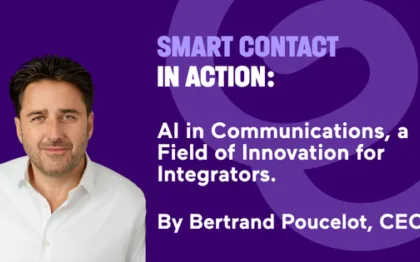
Smart Contact in Action: AI in Communications, a Field of Innovation for Integrators

Artificial intelligence has gradually made its way into professional tools, but its adoption by SMEs follows different dynamics compared to large enterprises. SMEs do not have the resources to conduct multiple experiments. Instead, they seek to integrate proven automation capabilities into work environments constrained by time, resources, and available skills.

BY YOUR SIDE WHEN YOU NEED US

Want to know more about how we work?
Whatever your communications needs, we have a solution that will help you transform the way teams collaborate, customers succeed and businesses operate. Let's discuss your needs together - we love meeting new and exciting people.