Generating website enquiries takes time and money, so every business wants to make the most of the leads they've worked hard to produce. Unfortunately, a lot of lead-generation processes fall short as soon as the web form is submitted. The enquiry passes through several systems and manual steps before it becomes a real conversation, and at each stage time is lost.
Speed to lead, the gap between a prospect submitting a website enquiry and someone in your team making contact, is the single biggest factor here: the shorter that gap, the more likely the lead converts. (For the evidence behind that, and why the effect holds across both B2B and B2C, see why speed to lead matters more than ever in 2026.) This article is about the practical side: where the delay creeps in, and how to design it out.
A typical process looks something like this:
The prospect completes a form
The enquiry enters a CRM or marketing automation platform
A notification is sent to a shared inbox or a salesperson
The lead is assigned to a team or individual
The salesperson reviews the information
The lead is added to a call list or follow-up task
Someone eventually makes contact
Every step looks reasonable on its own. The problem is the cumulative delay. Even when the CRM creates the lead instantly, the process still depends on someone seeing the alert, deciding what to do, and finding time to call. Automation has captured the enquiry, but it hasn't produced a conversation.
Many enquiries land in a general queue that several people can access but nobody owns. When responsibility is unclear, leads sit untouched: everyone assumes someone else has it, or new enquiries get buried among routine notifications.
When a manager or administrator has to review each enquiry and decide who handles it, routine leads that could be routed automatically pick up delay. It gets worse during busy periods, outside core hours, or when that person is away.
An email alert is not a response process. A new-lead notification competes with customer messages, meeting invitations and internal requests all day, and even a motivated team won't catch every one straight away.
Website enquiries often enter the same workflow as older prospect data, so someone who submitted a form seconds ago waits behind records uploaded days earlier. A high-intent enquiry gets treated like a standard outbound record.
Marketing measures form submissions while sales measures calls and revenue. In separate systems, neither team sees the full journey, so delays are hard to spot and fix.
In summary, CRM automation, on its own, often isn't enough. CRM workflows are useful for recording, assigning and tracking leads, and they can create tasks and send notifications automatically, but they usually stop just before the step that matters most: making live contact. A CRM can tell an agent to call, but the agent still has to see the task and act on it.

For high-intent enquiries, what matters isn't how quickly the lead enters the CRM, but how quickly the prospect speaks to someone. Not every lead needs an instant call, some need qualification or nurturing, others arrive out of hours. But when someone has actively asked for a conversation, a price or a demo, they shouldn't join a standard queue.
You can improve follow-up by deciding, in advance:
Which forms should trigger an immediate response
Which campaign each enquiry goes to, and which agents have the right skills
What happens when no agent is available, or it's outside opening hours
What information the agent needs before the call, and how outcomes are recorded
That gives you a response process based on customer intent, rather than one generic workflow for every submission.
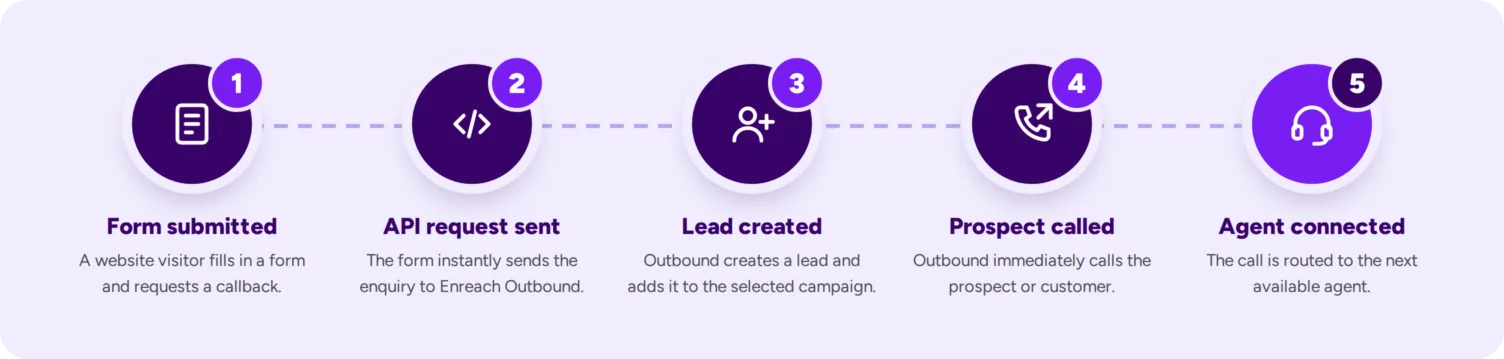
Enreach Outbound Web Callback connects website enquiries directly with your sales or support agents in real time, so there's no manual monitoring, dialling or list-building in between. The process runs like this:
A visitor submits a form on your website with their contact details, requesting a callback.
The form sends an API request to Outbound.
Outbound creates a lead and adds it to the selected campaign.
Outbound immediately calls the prospect or customer.
The call is routed to the next available agent.
The result is a faster, more consistent journey from online interest to a human conversation.
JFM, Denmark's second largest privately owned media group, wanted to follow up on web enquiries while prospects were still engaged. Using Web Callback, form submissions were routed straight to outbound agents within 5 to 30 seconds, often while the prospect was still on the website. Within three months, website lead conversion had increased by 157%.
As Commercial Chief Mikkel Banholdt put it: "It allows us to be as efficient as possible in converting web leads to sales and help our customers in the best possible way."
Read the full story in the JFM case study.
A faster response process works best when sales and marketing share responsibility for the outcome, looking past forms submitted and calls completed to what the two produce together. Useful measures include:
Time from form submission to first contact attempt, and to live conversation
Contact, qualification and conversion rates
Conversion by lead source
Reasons leads aren't contacted
Performance across different days and times
Tracking these together shows where follow-up breaks down, and can reveal whether a campaign generating fewer leads is actually producing more conversations and revenue.
Improving speed to lead isn't only about installing another tool. It's worth reviewing the whole process: what the prospect expects after submitting the form, who owns the enquiry, which system receives it, how it's prioritised, what happens when the responsible team is busy, what information reaches the agent, and how the result is measured. Technology can remove delays, but the workflow still needs clear rules and clear ownership.
Website leads shouldn't lose value while internal processes catch up. By connecting forms directly with Enreach Outbound, Web Callback lets businesses respond while the prospect is still engaged, prioritise high-intent enquiries and build a more connected journey between marketing and sales.
Speed to lead is easy to achieve with the quick-to-implement web callback widget from Enreach Outbound. Talk to us today by emailing: outbound@enreach.com or calling: +4570202304