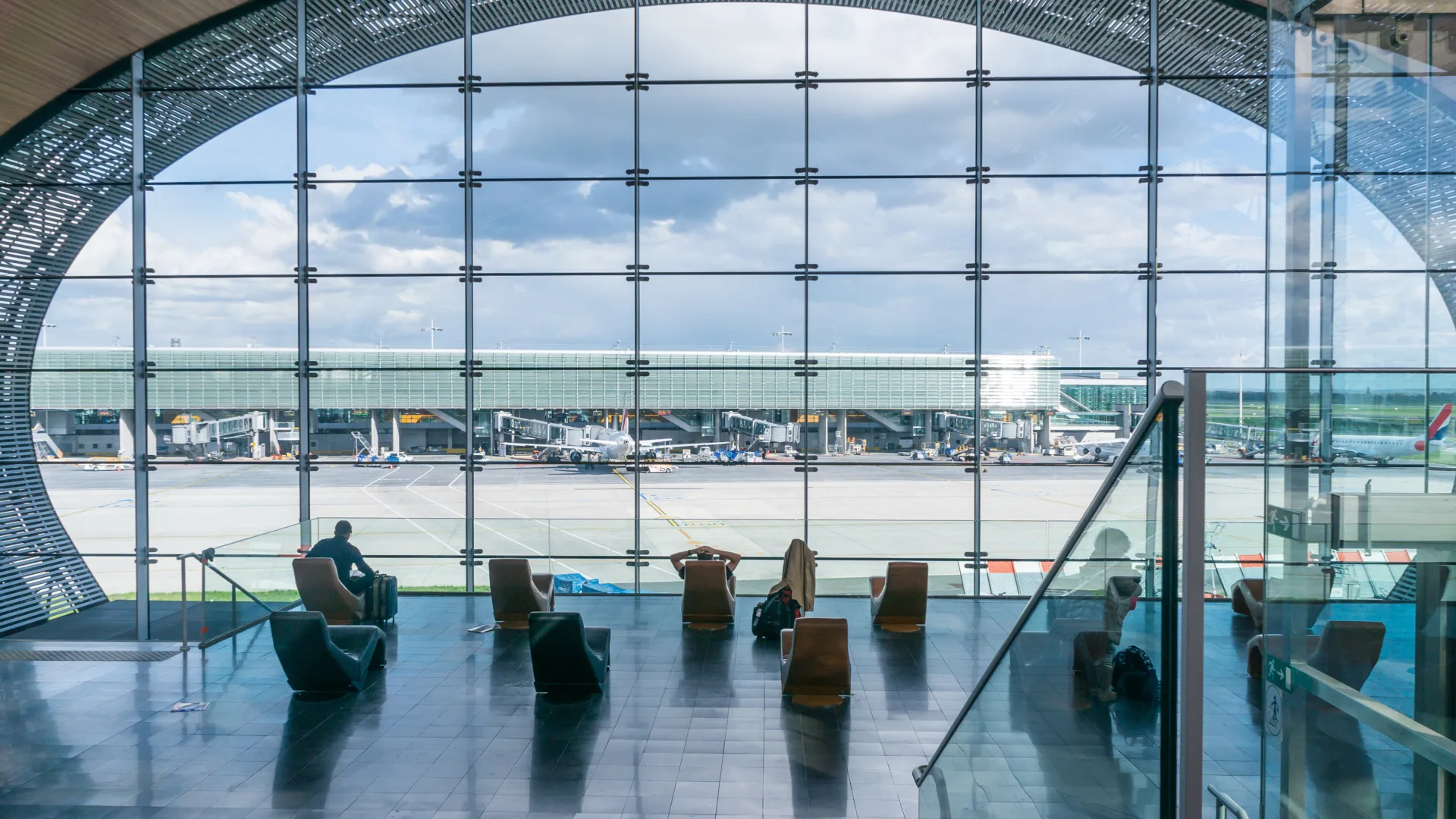

At 3am, an emergency phone rings on the runway apron. A security team must answer. Instantly. Without fail. This is the reality Hub One operates in every single day — and the standard against which this entire infrastructure transformation was measured.
| Indicator | Value |
|---|---|
| Total telecom lines operated | 15 000 |
| Analogue lines migrated | 7 000 |
| Lines already on VoIP | 8 000 |
| Total project duration | 6 months |
| Effective migration window | 2 weeks |
| Service interruptions | 0 |
| Solution deployed | Enreach UP |
| Sector | Critical aviation infrastructure (ERP-classified) |
Hub One — the backbone of communications at France's busiest airports
Few organisations understand the true cost of a dropped call better than Hub One. As the dedicated telecom operator and systems integrator for the Paris-Charles de Gaulle and Paris-Orly airport platforms, Hub One is a subsidiary of Groupe ADP (Aéroports de Paris) and the nerve centre for all voice communications across both sites.
Its network of over 15,000 lines spans a broad operational spectrum: runway emergency phones, inter-terminal coordination, airline operations, ground handling services, retail and passenger assistance. Every single line plays a role in keeping the airports running safely and efficiently. These environments are classified as ERP (Établissements Recevant du Public — public-access facilities subject to strict safety regulation), where communication continuity is not a service-level objective. It is a legal and operational imperative.
Since 2018, Hub One has been delivering its SmartCall unified communications offer to its business clients — a suite built on the Enreach UP platform covering cloud telephony, collaboration tools, CRM integration, and, in the near future, AI-powered capabilities including virtual assistants and automatic call transcription.
Beyond SmartCall, Hub One also provides SIP Trunk solutions with VoIP gateways, enabling legacy analogue equipment (PABX and IPBX systems) to carry voice traffic over IP networks — ensuring that operators can extract value from existing hardware rather than replacing it prematurely.
Replacing the engine while the plane is flying
A system built for resilience — but approaching its limits
Hub One's legacy infrastructure had been engineered with one priority above all others: uninterrupted availability. It relied on first-generation IP transport technologies, high-density analogue VoIP gateways (MSAN), and a segmented, redundant architecture that had served its purpose well for years.
But two converging pressures made transformation unavoidable.
Technology obsolescence. First-generation IP systems were approaching end-of-life. Spare parts were becoming harder to source, manufacturer support was thinning out, and client expectations had evolved well beyond what the legacy platform could deliver. Demand for advanced supervision, unified messaging, and application-layer integrations was growing — none of which the existing infrastructure could accommodate.
Rising operational costs. Keeping ageing, mission-critical hardware in full operational condition (a process known in French operations management as maintien en condition opérationnelle, or MCO) was consuming an increasing share of budget without generating new value. Each maintenance cycle was more expensive and more complex than the last.
The strategic question Hub One faced was not whether to transform — that was already decided — but how to do so without ever exposing its airport clients to even a moment of communication failure.
"Given the technical constraints and the criticality of certain lines, we needed a close-proximity partner capable of mastering the full complexity of the subject."— David Debert, Product Manager, Hub One
A phased, hybrid architecture built around operational continuity
Why a clean-cut migration was never an option
In airport environments, telephony is woven into the security fabric. Emergency lines on the tarmac, coordination channels between control towers and ground crews, direct lines to fire and medical services — these cannot be taken offline, even briefly, for a technology upgrade. Any transformation strategy that began by switching off the old system before the new one was proven would have been immediately disqualified.
The approach developed jointly by Hub One and Enreach was built on three engineering principles:
1. Controlled hybridisation. Rather than replacing legacy MSAN gateways immediately, they were progressively integrated into the existing Enreach UP architecture as first-class participants. Analogue lines retained their intrinsic resilience properties while gaining access to a unified service layer — supervision, routing, and management — alongside their VoIP counterparts.
2. Sequenced, validated switching. Every line transfer was planned in detail, tested under operational conditions, and formally validated before activation. End users experienced no disruption whatsoever. The full migration of all 7,000 analogue lines across both Paris-CDG and Paris-Orly was completed within a two-week window.
3. Centralised, future-ready architecture. Enreach UP now centrally orchestrates both the 7,000 remaining analogue lines and the 8,000 lines already running on VoIP. Traffic management, security, and supervision are consolidated into a single unified framework — eliminating the operational silos that had previously added complexity and cost.
H3: What made Enreach UP the right fit
Enreach UP was selected precisely because of its ability to operate across heterogeneous environments without forcing a binary choice between legacy and modern. Its architecture is designed to interconnect with complex operator infrastructures and manage multi-generation deployments simultaneously. Crucially, every line connected to the platform — including the simplest analogue extension — benefits from the same unified service layer, regardless of its physical technology.
Operational continuity maintained. Future capability unlocked.
The architecture now in place delivers what Hub One set out to achieve from the beginning: the reliability of the old world, combined with the agility of the new.
Zero tolerance for downtime — achieved. The full migration was completed without a single visible interruption for end users. In an environment where a missed emergency call has real-world safety consequences, this outcome is the most significant measure of success.
Legacy resilience preserved where it matters. Segmented traffic flows, analogue line robustness, and equipment redundancy are maintained for the use cases that specifically require them — primarily emergency and security communications.
Cloud-native capabilities now within reach. Integration with the Enreach UP hosted architecture opens the path to advanced unified communications, enriched supervision dashboards, and progressive rollout of AI-powered services — none of which were accessible on the legacy platform.
Operational costs brought under control. Centralising infrastructure management significantly reduces MCO complexity. The architecture is also designed to absorb the progressive decommissioning of remaining legacy hardware as it reaches end-of-life, rather than requiring another large-scale transformation project.
A transformation blueprint for any critical infrastructure operator
The methodology developed through the Hub One project is not specific to aviation. It addresses a structural challenge shared by a wide range of sectors: the need to modernise communications infrastructure that cannot afford downtime, within environments where mixed-generation equipment is the norm rather than the exception.
Sectors where this approach applies directly include:
- Rail networks and urban transit operators — managing safety-critical communications across live, in-service lines
- Logistics hubs and industrial sites — interconnecting heterogeneous systems across large, operationally complex estates
- Healthcare facilities and hospital networks — guaranteeing communication availability in critical care environments
- Government and defence installations — where security, resilience and compliance requirements are non-negotiable
- Energy and utilities infrastructure — operating distributed sites with strict availability requirements
In each of these contexts, the Hub One × Enreach model demonstrates that legacy integration, progressive migration and cloud-native evolution are not mutually exclusive. They can be sequenced, orchestrated and delivered without a single moment of operational risk.
Read the full case study
Explore the complete technical and operational detail of the Hub One × Enreach project: infrastructure architecture, migration methodology, results achieved, and lessons applicable to your own transformation challenges.
Download here the PDF
Go further with Enreach